Last week I attended the Teaching and Learning with AI Conference and listened to a presentation from France Hoang, CEO of BoodleBox about how AI is changing our jobs. There is a lot of discussion around it replacing humans, but I’ve been skeptical. This is not what technology has produced in the past as more jobs are created than destroyed. A better way of thinking about it is that AI changes tasks rather than people. In other words AI is changing how we work, not if we work.
The Four Stages of Problem Solving
Hoang talked about the four stages to solving a problem.
- Define the Problem: This is where we figure out what it is we want to accomplish. What is the nature of the problem, and what is the desired outcome?
- Design a Solution: We come up with what we think will solve the problem and produce the outcome that we are after.
- Implement the Solution: This is the execution stage where we apply our solution to the problem.
- Validate Results: We check to be sure that the solution was implemented correctly and we check that it is giving us the results that we are after.
AI Is Changing How We Work
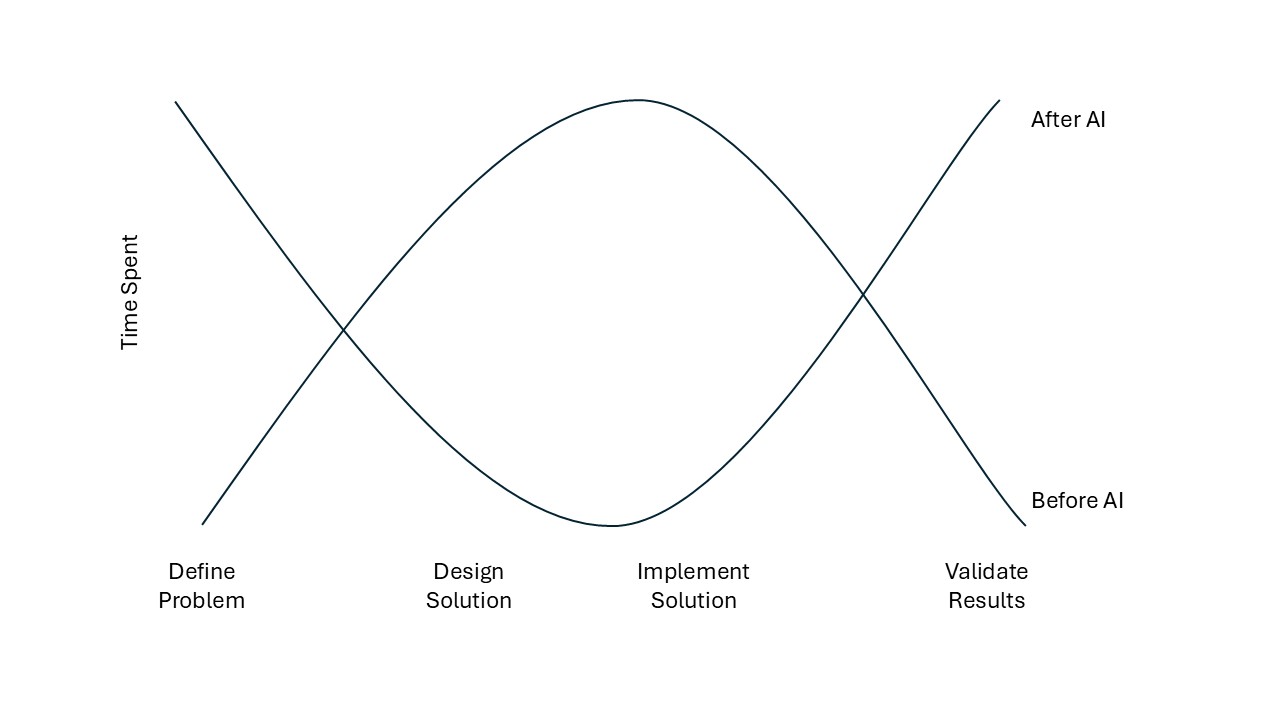
Hoang pointed out that if we look at how people are using AI today, often it affects where we put effort. The graph to the right, based on his presentation, shows that prior to the adoption of AI, people spent little time defining problems or validating results. Most of their effort was in the design and implement stages. The first and last stages are often given little attention. This is unfortunate because poorly defined problems lead to poorly designed and too often, ineffective solutions. I tell students in my research methods classes that when research projects go wrong, it is most often because the problem was not defined precisely enough. The same is true of creating solutions in practice.
The lack of validation means that we fail to recognize that solutions are not being properly rolled out, or that solutions that we are investing resources into are ineffective. What AI is doing is taking on much of the design and implementation work, freeing time to pay more attention to defining and validating. In part this is driven by the need to clearly specify the problem in order for AI to accomplish it, and the need to double-check everything AI does because it cannot be trusted to work without close supervision, particularly during stages where it is helping to create something new.
AI As a Not Very Capable Assistant
The capabilities of AI are amazing, and it has the potential to save us countless hours, but it is far from perfect. The benefits come from spending time at the front end and back end. Garbage in/Garbage out characterizes how we work with it. If you are not 100% clear about what you want, don’t expect AI to figure it out for you. And even clear instructions can result in wrong answers. This means that at the back end you have to double-check everything. Today I am working on an agent to auto-answer certain kinds of request emails I get every day. I am asking AI to help set it up, but what it is giving me is not always correct. It says to click a certain icon on the screen, and that icon doesn’t exist. It tells me to chose a particular option, but the name it gives me is not what it is called. I am muddling through considering the AI as providing hints and not necessarily correct answers. But I must admit, even with the inaccuracies and false starts, it is much quicker with AI than to do an internet search for instructions, and then try to figure it out by consulting multiple websites and documents. AI has done that for me, although not always as well as I would like.
All this is to say that I am already seeing that AI is changing how we work with my own tasks. More and more often I am relying on AI to help, not because I trust it to be perfect, but because it is quicker to put effort at the front and back ends than to do all the work in the middle.
Image from Pexels.
SUBSCRIBE TO PAUL’S BLOG: Enter your e-mail and click SUBSCRIBE